
A forklift hand brake — also called the parking brake — is the lever-operated assembly that locks the truck’s wheels when parked. The operator pulls the hand lever, which tensions cables or linkages to engage the brake shoes or pads, holding the forklift stationary on level ground and gradients. As a primary safeguard against unintended truck movement, the hand brake is a safety-critical operator control.
What It Does
- The hand lever, mounted within the operator’s reach, applies the parking brake through cables or mechanical linkages.
- A ratchet and pawl mechanism holds the lever in the engaged position until the operator releases it.
- The applied force clamps the brake shoes against the drum (or pads against the disc), preventing wheel rotation.
- On many forklifts the hand brake works together with the service (foot) brake system on the same wheel brakes.
- Correct adjustment ensures the truck holds securely on the gradients specified for the application.
How to Select the Right Hand Brake
- Match the lever and mounting geometry. Lever length, pivot position, and mounting bracket hole patterns must fit the operator compartment layout.
- Confirm cable or linkage specifications. Cable length, end fittings, and travel must match the existing routing and the wheel brake actuation points.
- Check ratchet holding performance. The ratchet teeth and pawl must engage positively across the full lever travel without slipping.
- Verify compatibility with the brake type. Drum and disc wheel brakes require different actuation forces and lever ratios.
- Consider ergonomics and variants. Lever effort, grip design, and left/right-hand configurations affect operator comfort and safety.
- Use the OEM reference or a sample. Hand brake assemblies vary widely by truck series; the OEM number or an original sample is the most reliable identification.
Common Failure Signs
- The lever pulls up with little resistance and the truck still rolls, indicating stretched cables or worn linings.
- The ratchet fails to hold the lever, or the lever slips back down on its own.
- Cables are frayed, kinked, or seized, producing uneven or delayed engagement.
- Pivot points are worn or corroded, causing excessive play or sticking.
- The truck cannot hold on gradients it previously handled, pointing to adjustment limits or lining wear.
A hand brake that cannot reliably hold the truck is an immediate safety issue and should be serviced or replaced before the forklift returns to operation.
OEM Cross-Reference Coverage
STARSAN manufactures hand brake assemblies matched to OEM samples and drawings across the major forklift brands, including:
- Toyota / TCM / Mitsubishi / Komatsu / Hyundai / Hyster / Linde / Hangcha / Heli / Nissan: model-specific hand brake assemblies available on request
Hand brake designs differ substantially between truck series; final fitment is confirmed against the supplied reference part, specifications, and application details. Brand names are used for identification reference only.
Why STARSAN
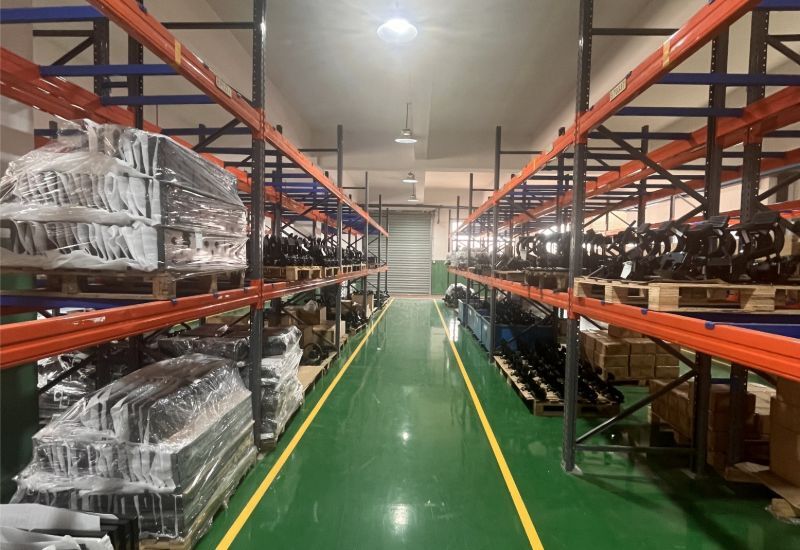
- Ningbo Xingcheng Engineering Machinery Co., Ltd. (brand STARSAN), founded in 2017 in Yuyao, Zhejiang, China, specializes in forklift brake systems, steering components, and operator control assemblies including hand brakes.
- The company employs 120+ people, including 30+ technical staff, with an annual parts capacity of 50,000+ sets.
- Certified to ISO 9001:2015 and ISO 3834 with IIW welding certification; a German TRUMPF production management system has been in operation since 2020.
- In-house stamping, welding, CNC machining, and assembly deliver complete hand brake assemblies with consistent quality, serving OEM and aftermarket customers including Hyster-Yale, Hyundai, BYD Forklift, Lonking, and Noblelift, with exports to Germany, Turkey, India, Brazil, Vietnam, Korea, Malaysia, and Thailand.
Request a Quote
To receive an accurate quotation, please provide:
- The OEM reference number (preferred), or an original sample
- The forklift brand, model, and tonnage
- Photos showing the lever, mounting bracket, and cable end fittings, or technical drawings
Contact: Lucy Cheung (Sales Director), +86 180 0670 2081, lucy.cheung@starsan.com | www.starsan.com
How to select the right hand brake
- Lever vs pedal type. Match the truck’s original parking brake design — the cab mounting differs.
- Cable length and end fittings. Measure the old cable routing; end fittings (clevis, ball, eyelet) must match the brake actuator.
- Mounting bracket. Bolt pattern and bracket geometry must fit the cab or chassis mounting points.
- Ratchet holding force. The locking mechanism must hold the rated load on a grade — never substitute an under-rated unit.
Hand brake FAQ
What does the hand brake (parking brake) do?
It mechanically locks the brakes when the forklift is parked — independent of the hydraulic service brake system.
What are the signs of a failing hand brake?
Lever pulls up too far with little resistance, the truck creeps on a slope with the brake applied, or the ratchet no longer clicks and holds.
Can the hand brake be adjusted instead of replaced?
Cable stretch can sometimes be adjusted at the equalizer — but a worn ratchet, frayed cable or cracked lever means replacement.
How do I confirm fitment before ordering?
Provide the forklift brand, model, and photos of the lever assembly and cable ends. We verify before quoting.
How do I get a quote?
Email lucy.cheung@starsan.com or call +86 180 0670 2081 (Lucy Cheung, Sales Director) with your forklift brand, model, and quantity.

 English
 German
 French
 Italian
 Spanish
 Russian
 Korean
 Portuguese
 Turkish
 Arabic